
How Many Days Do You Need in Ottawa?
Plan one to three full sightseeing days in Ottawa: one day suits a focused highlights visit, two days balances coverage with visit depth, and three days adds room for longer visits, neighbourhoods, breaks and a slower pace. Count full sightseeing days rather than hotel nights, because arrival and departure timing can reduce the usable sightseeing time in a booked stay.
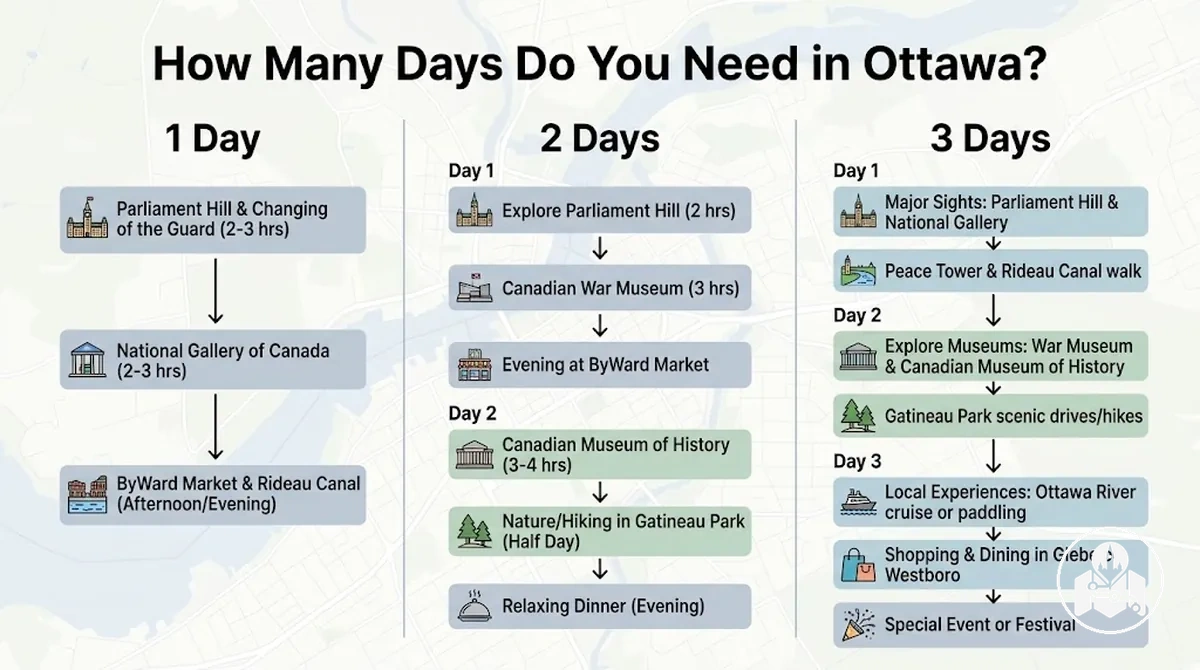
Choose your Ottawa stay length
Match the number of full sightseeing days to the coverage, depth and pace you want.
Planning rule: move toward more time when your priorities broaden, visits get longer, your pace slows, or arrival and departure reduce usable hours.
Usable sightseeing time, priorities and pace matter more than the calendar label alone. A full sightseeing day gives you more room than a travel day with only a few free hours; broader priorities, longer museum visits or neighbourhood exploration also increase the time needed.
A faster pace can concentrate more into the available hours, while a slower pace increases the value of extra time. The useful comparison is therefore coverage and depth per full sightseeing day, not a universal number of nights that suits every visitor.
Table of Contents
How Much of Ottawa Can You Experience in One, Two and Three Days?
One full sightseeing day in Ottawa can support a focused visit built around narrower priorities, while two to three full sightseeing days generally create more room for broader coverage, greater visit depth and a less compressed schedule.
Each additional full sightseeing day increases the available time budget, but the practical value of that time still depends on what you want to see and how quickly you prefer to travel.

The comparison below uses the same criteria for one day, two days and three days: realistic coverage, visit depth, schedule pressure and flexibility.
This keeps the focus on what each stay length can reasonably support rather than treating any duration as universally suitable.
| Stay length | Realistic coverage | Visit depth | Schedule pressure | Flexibility | Suitable context |
|---|---|---|---|---|---|
| One full sightseeing day | Focused coverage of a limited set of core highlights | Shorter or more selective visits | More compressed because fewer usable hours are available | Limited room for longer stops or changes of plan | A short stay with narrow sightseeing priorities and a faster pace |
| Two full sightseeing days | Broader coverage across major sights and selected secondary interests | More room for longer visits or an additional museum or neighbourhood experience | Less compressed than a one-day visit | More room to adjust timing and priorities | A short stay seeking a balance between sightseeing breadth and visit depth |
| Three full sightseeing days | Broader coverage with more time for secondary sights or slower exploration | More opportunity for extended visits and deeper exploration | Lower pressure to combine many priorities into the same day | Greater room for longer stops and changes in pace | A short stay with wider interests, deeper visits or a slower travel pace |
The strongest trade-off is between compression and flexibility.
One day concentrates limited time around fewer priorities, while two and three days progressively increase the room for broader coverage or greater visit depth without requiring every activity to fit into the same tight schedule.
This comparison defines the planning difference between the three stay lengths without turning them into day-by-day routes.
Once the trip length is chosen, Ottawa travel itineraries can provide the separate route-level planning context.
One Day: A Focused Introduction to Ottawa
One full sightseeing day in Ottawa can provide a focused introduction when your priorities are narrow and you have sufficient usable hours.
With limited time, the visit works by concentrating on a smaller set of core highlights rather than trying to cover Ottawa broadly.

Two Days: A Balanced Short Stay
Two full sightseeing days in Ottawa reduce schedule pressure by providing a larger usable time budget than a one-day stay.
The second day adds room for broader coverage or greater visit depth, with the practical benefit depending on your priorities and pace.

How to use the second day
Use it for breadth
Fit more major sights into the short stay and widen coverage beyond what a one-day visit can comfortably support.
Use it for depth
Allow longer visits and more flexibility around selected interests, such as combining landmark sightseeing with a longer museum or neighbourhood experience.
Once you know whether the extra day is mainly for breadth or depth, you can plan two days in Ottawa at itinerary level.
Three Days: More Depth and Flexibility
Three full sightseeing days in Ottawa create more room for visit depth, flexibility and a slower pace rather than simply adding more stops.
The third day can accommodate longer visits, breaks or schedule changes, while its planning value still depends on your priorities.

If that amount of depth and flexibility matches your priorities, you can plan three days in Ottawa at itinerary level.
What Determines How Long You Should Stay in Ottawa?
Ottawa trip length depends on four interacting decision criteria: visit history, sightseeing priorities and desired depth, travel pace, and genuinely usable days.
These criteria affect how much sightseeing time you need rather than producing one fixed number of days for every visitor.
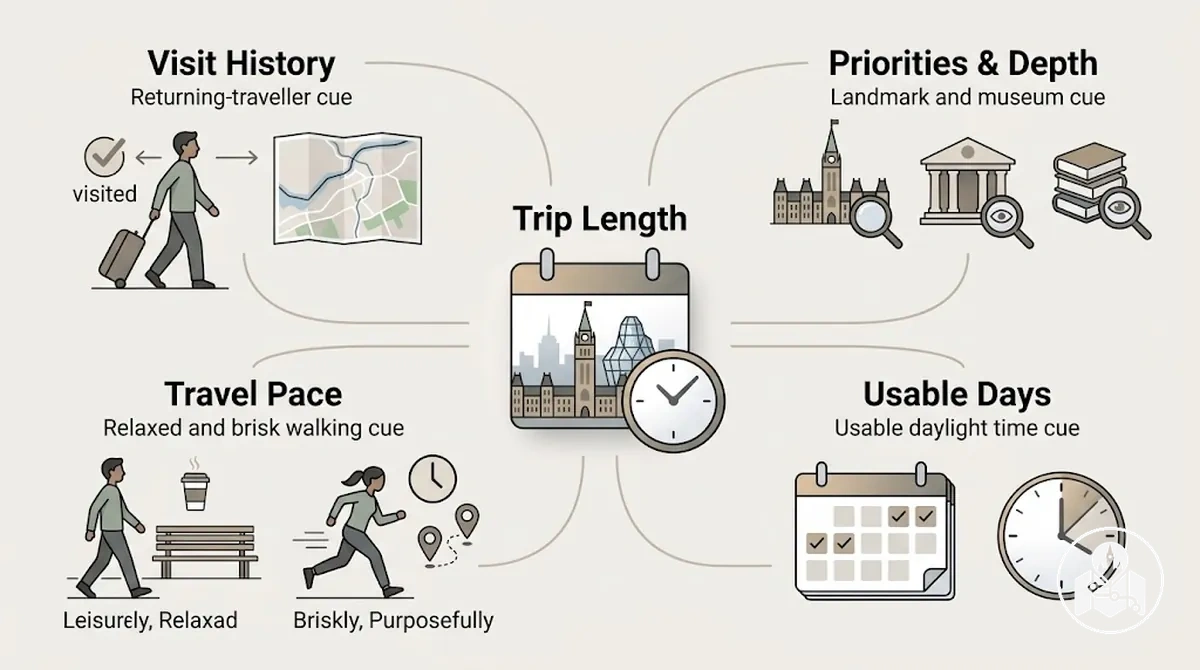
Each criterion changes usable sightseeing time, desired coverage or schedule pressure, so its directional effect matters more than treating it as an isolated preference.
The four planning variables work in these directions:
- Visit history: Greater familiarity can reduce the time needed for broad introductory sightseeing when a return visit has narrower priorities.
- Priorities and depth: More priorities or deeper experiences increase the time needed if you want to avoid compressing everything into a tighter schedule.
- Travel pace: A slower pace increases the time needed for the same priorities; a faster pace can support a more concentrated stay.
- Usable sightseeing time: Fewer genuinely usable hours increase schedule pressure, so calendar days or hotel nights alone do not describe the time available.
No single criterion determines trip length in isolation because the variables interact.
A fast first-time visitor with narrow priorities may need less time than a slower repeat visitor pursuing several in-depth experiences, so the stay-length decision should reflect the combined effect of visit history, priorities, pace and usable sightseeing time.
First Visit or Return Visit
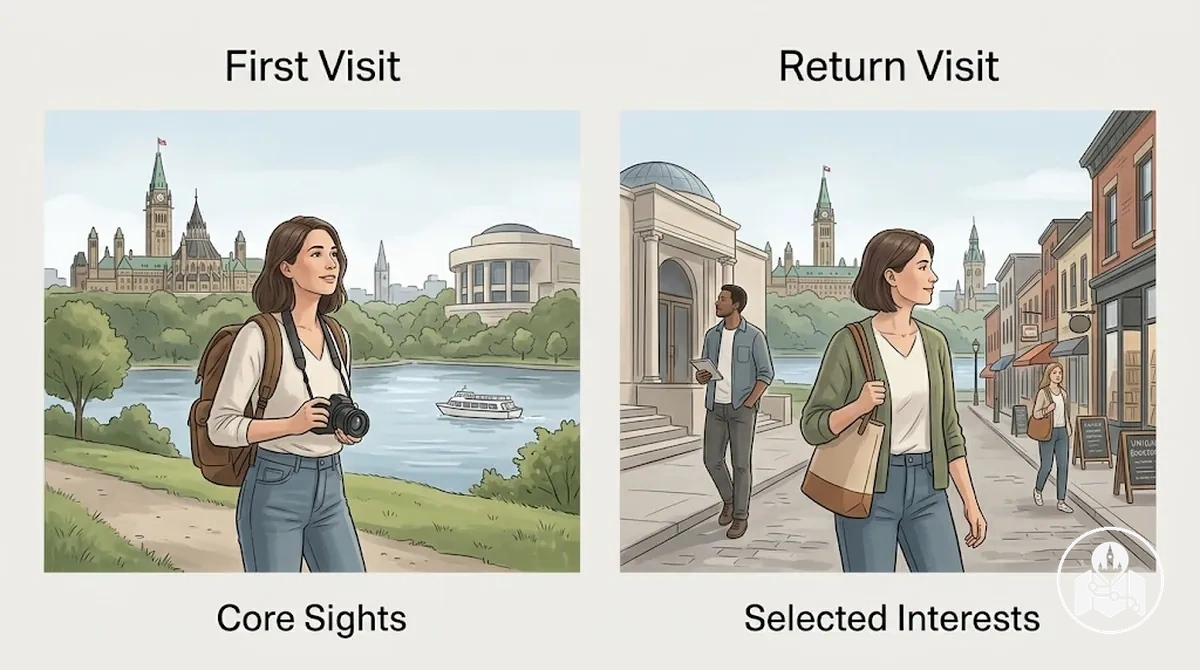
Visit history can change how much time you need in Ottawa because a first visit often comes with less familiarity and broader priorities around core sights, while a return visit may concentrate on selected interests.
The amount of sightseeing you want to cover matters more than familiarity by itself, so being a first-time or repeat visitor does not determine the stay length on its own.
Sightseeing Priorities and Desired Depth
Sightseeing priorities and desired depth change time demand: more priorities broaden the coverage you are trying to fit into the stay, while deeper experiences concentrate more time on each priority.
The trip-length implication therefore depends on how you divide usable days between breadth and depth.
Breadth or depth?
Breadth-focused planning
Spread the available sightseeing time across more priorities and multiple areas.
- Use quicker landmark viewing so more priorities can fit into the available time.
- Covering multiple areas broadens the visit but increases the time and organisation needed.
- More usable days become helpful when the priority list is broad and cannot be narrowed.
Depth-focused planning
Concentrate sightseeing time on fewer priorities and give individual experiences more time.
- Longer visits, such as more time in museums, increase the time spent per experience.
- Fewer priorities can work when greater depth matters more than broad coverage.
- More usable days become helpful when you want deeper visits while still keeping several priorities.
Quick landmark viewing can support broader coverage in the same available time that longer visits devote to fewer experiences. Covering multiple areas can also increase the time and organisation burden, so organise attractions by area separately when that becomes part of the planning task.
Travel Pace and Daily Sightseeing Time
Travel pace changes how much usable sightseeing time the same nominal stay provides.
What changes with pace
Faster or tightly scheduled
Can support more activity within the available hours. Shorter stops can increase coverage, but limited flexibility can raise schedule pressure.
Slower or more relaxed
May reduce daily capacity, while leaving more room for breaks, longer visits and changes of plan. The same priorities can therefore require more full sightseeing days.
Break frequency and activity duration also change daily capacity: more frequent breaks or longer visits reduce how many activities fit comfortably into the same usable hours.
When a dense schedule starts reducing flexibility, it can help to avoid overpacking your Ottawa itinerary rather than treating faster pacing as automatically better.
Full Sightseeing Days vs Arrival and Departure Days
A booked duration measured in calendar dates or hotel nights is not the same as the number of full sightseeing days available.
Arrival and departure days often function as partial sightseeing days when travel timing reduces the hours available.
Arrival and departure timing therefore changes effective sightseeing time even when two stays have the same booked length.
An earlier arrival and later departure can leave more usable time, while a later arrival and earlier departure can reduce it.
| Booked stay | Arrival/departure pattern | Usable sightseeing time | Planning implication |
|---|---|---|---|
| Similar number of hotel nights | Earlier arrival and later departure | More usable sightseeing time across the arrival day, full sightseeing day or days, and departure day | The booked duration provides greater effective sightseeing capacity because the partial days contribute more usable time |
| Similar number of hotel nights | Later arrival and earlier departure | Less usable sightseeing time because the arrival day and departure day contribute less to sightseeing | The same nominal stay provides less effective sightseeing capacity because the partial days contribute less usable time |
Plan with effective sightseeing time rather than hotel nights alone: equal booked durations can provide different amounts of usable sightseeing time depending on how much of the arrival and departure days is actually free.