
One Day in Ottawa: A Practical Sightseeing Itinerary
For one day in Ottawa, keep the route compact: start with Parliament Hill and the Rideau Canal area, continue through ByWard Market, then add one museum or secondary landmark only if the remaining time, access and route position still fit. Treat booked entry or limited opening windows as fixed constraints, and shorten or remove lower-priority stops when delays build.
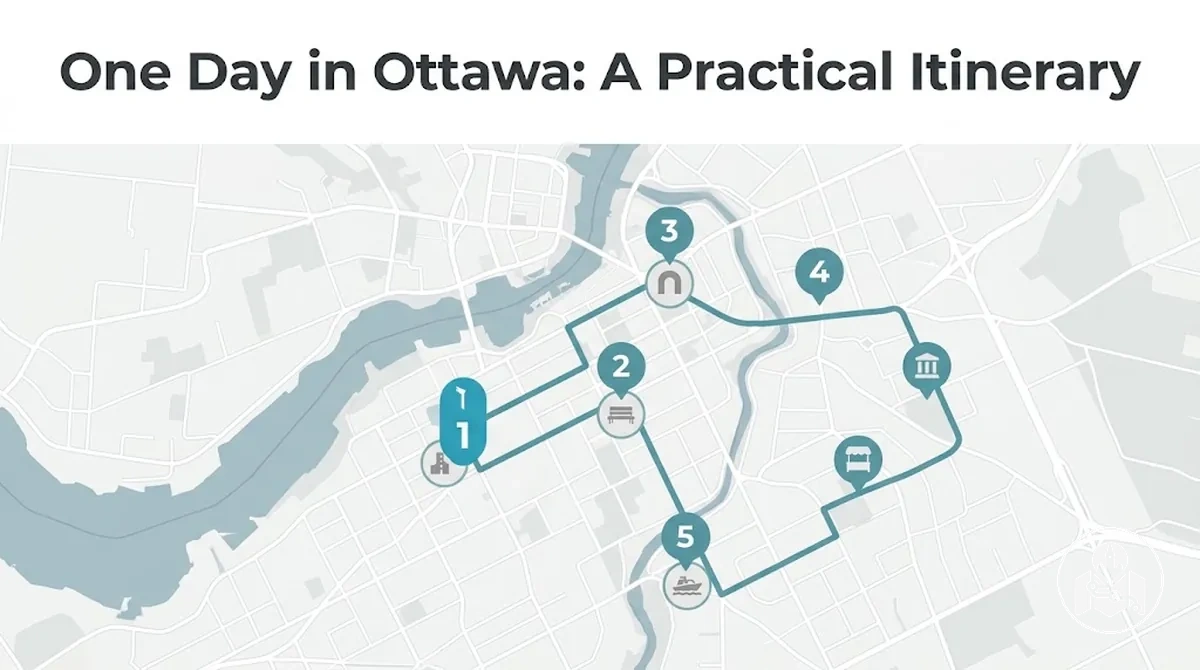
One-day Ottawa plan at a glance
Use the sequence as a planning framework rather than a fixed timetable. Time spent at each stop, queues, access and walking pace determine how far the day can comfortably extend.
- Morning: protect time for Parliament Hill, then continue to the nearby Rideau Canal area.
- Midday: use ByWard Market as the central anchor and avoid unnecessary backtracking.
- Afternoon: add one substantial museum or secondary landmark only when its location, likely visit length and access window fit.
- Evening: finish with one distinct nearby experience only if time, daylight or opening hours, and energy still support it.
Adjustment rule: protect the highest-priority remaining experience first; when time is lost, shorten or remove a lower-priority or distant stop before compromising the core route.
The itinerary is intentionally flexible: geographic proximity, time at each stop, queues, opening hours and walking pace determine how much can fit without turning the day into a rushed checklist.
Table of Contents
Plan a Realistic One-Day Ottawa Route
A realistic one-day Ottawa route protects high-priority central attractions while limiting avoidable travel between them. Route feasibility depends on how closely the stops fit together and how much time each visit, queue, access condition and transfer consumes.
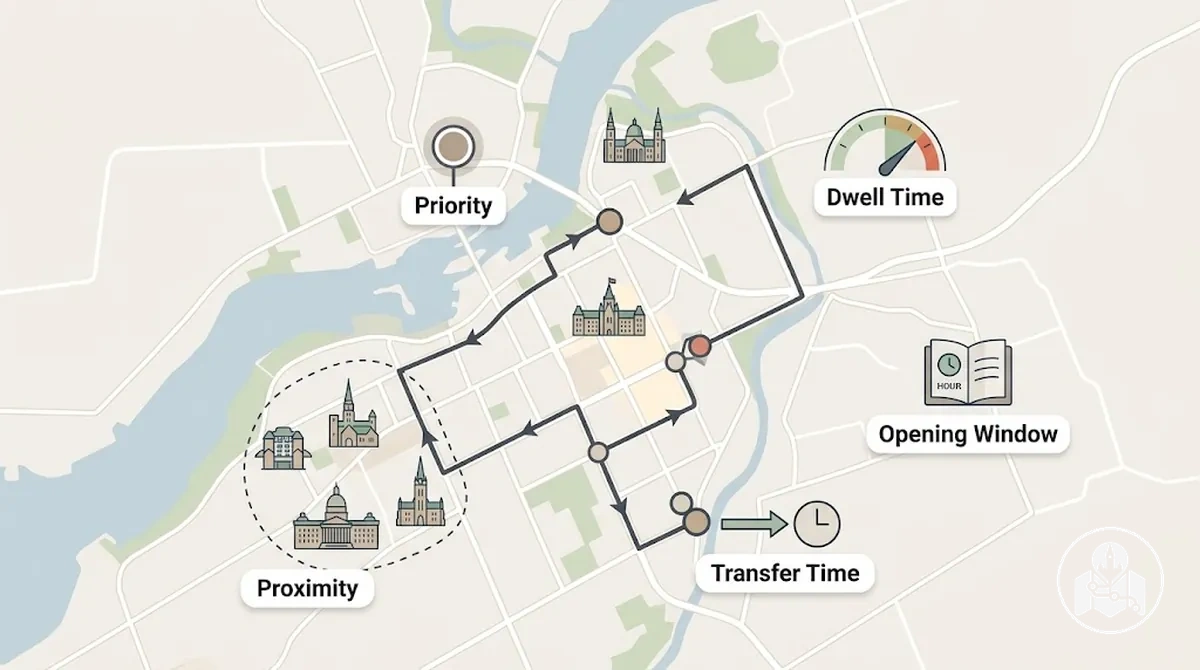
Plan the route around priority, geographic proximity, expected time at each stop, opening or booked-entry windows, and transfer time. Priority protects the most important sights; proximity reduces backtracking; longer visits and transfers reduce the time available elsewhere.
A compact route is easier to assess when these linked constraints are considered together, and it can help to group nearby Ottawa attractions before fixing the stop order.
Opening windows and booked access are fixed constraints when they apply, while lower-priority stops and dwell time remain more flexible.
The criteria below show how each condition changes route priority or time allocation.
- Priority: Protect time for the central attractions that matter most to the visit; lower-priority stops remain flexible if the schedule tightens.
- Geographic proximity: Place nearby stops together where practical; a distant stop can create extra travel and reduce the time available for other visits.
- Dwell time: Give a longer or more detailed visit more time in the schedule; extending one stop means later stops may need to be shortened or removed.
- Opening windows: Treat booked access or limited opening periods as fixed constraints when they apply; flexible stops can then be arranged around those windows.
- Transfer time: Allow for the time needed to move between stops; longer transfers reduce the sightseeing time available elsewhere in the route.
Prioritize Parliament Hill, the Rideau Canal and ByWard Market on a First Visit
Parliament Hill, the Rideau Canal and ByWard Market form the core first-visit stops for this one-day route because they are major central sights that fit efficiently into the same sightseeing area. Their priority here comes from route fit and first-visit usefulness, not from ranking them against every Ottawa attraction.

For each stop, first-visit significance and central location support inclusion, while likely visit length and access conditions determine how much of the schedule it receives. Their proximity to other central sights is what makes the three practical within the same route.
- Parliament Hill: Its first-visit significance and central location support protected time in the route, while its compatibility with nearby central stops helps keep the sightseeing sequence compact. Dwell time should remain flexible because access, tours, and on-site activities can change how long the visit requires.
- Rideau Canal: Its first-visit relevance and central position make it practical to combine a canal viewpoint or nearby sightseeing stop with the other priority sights. Dwell time can remain flexible because the type and length of the canal experience may change with the chosen activity, access conditions, and season.
- ByWard Market: Its first-visit relevance and central location support including it in the same sightseeing sequence as nearby stops. Dwell time can expand or contract according to visitor interest, access conditions, and the time remaining in the schedule.
Tours, access conditions, and seasonal experiences can vary, so they should affect the schedule only when their current availability is confirmed.
Keep Parliament Hill, the Rideau Canal, and ByWard Market as route priorities while adjusting their individual time allocations to the conditions of the visit.
Keep the Day to a Realistic Number of Major Stops
There is no useful fixed stop count for every one-day Ottawa itinerary. The feasible number depends on time spent at each attraction, transfer time, queues, opening constraints and how deeply you want to visit each place.
Dwell time increases when a visit is explored in greater depth, while a brief visit can leave more time for other stops.
Walking or other transfer time consumes time between attractions, and backtracking can increase that burden.
Queues and opening windows can restrict when a stop fits into the schedule, while greater visit depth generally means allocating more time to fewer substantial stops.
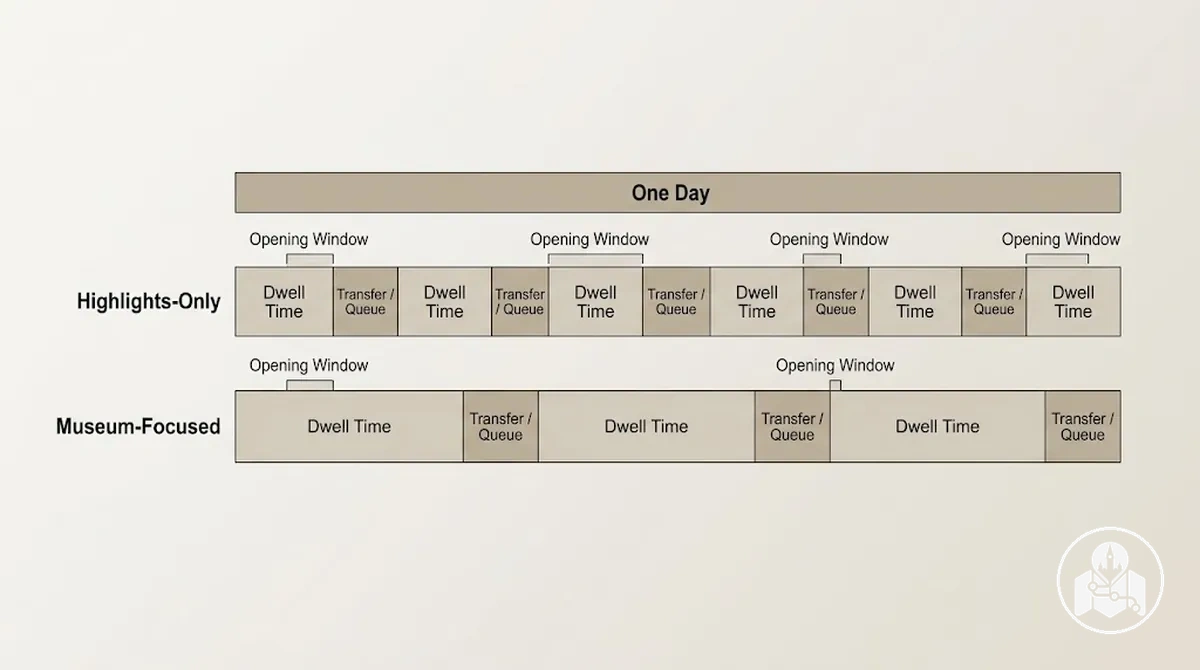
More brief visits can fit when attractions are close together and delays are limited, because less time is spent at each stop.
Fewer major stops usually fit when one substantial indoor visit consumes more of the day, especially when queues or transfers also take time.
Practical rule: the stop count is an output of visit length, transfer time, queues, opening constraints and visit depth—not a target to maximise.
Follow the One-Day Ottawa Itinerary from Morning to Evening
The morning-to-evening Ottawa itinerary sequence should start with protected time for priority attractions in the morning, continue to nearby stops around midday, allow a conditional choice in the afternoon, and finish with a flexible evening stop based on remaining time.
This route keeps the day organised without turning it into a fixed timetable.
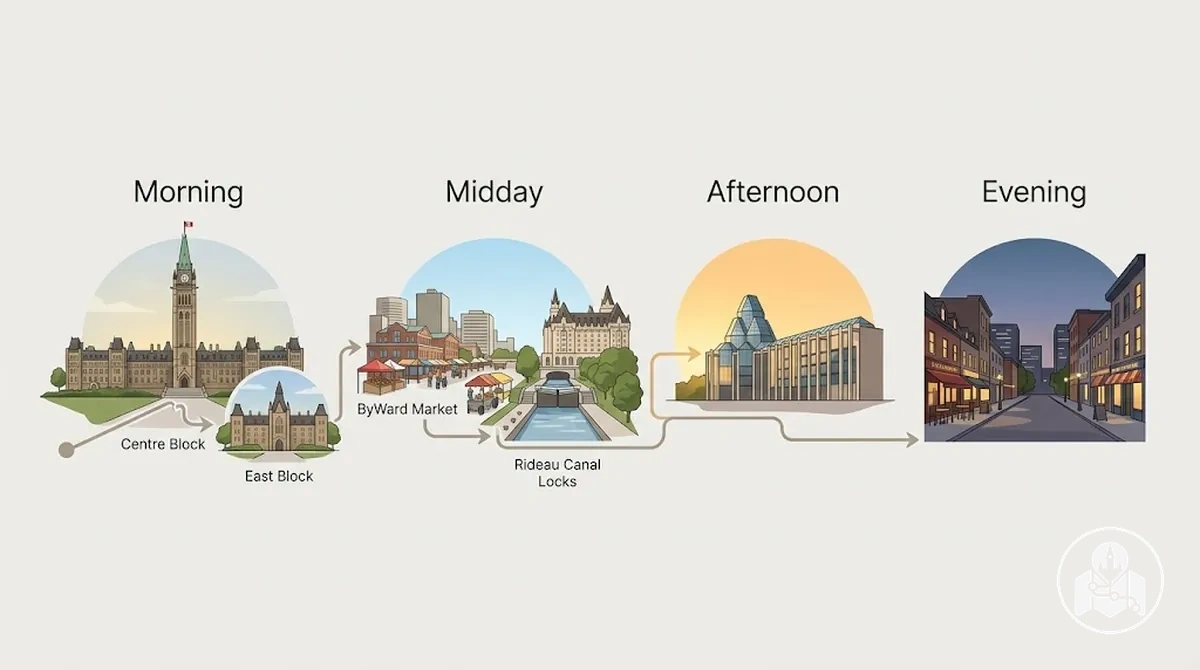
The sequence is intended to reduce unnecessary backtracking while protecting time for the central sights that matter most to the day.
Moving from morning priorities to compatible nearby stops at midday leaves the afternoon and evening more adaptable when dwell time or travel between stops changes the itinerary flow.
Opening hours, tours, walking pace, and unexpected delays can change the exact order, so the afternoon choice and evening finish should adjust to the remaining time.
The route sequence is therefore a planning framework rather than a guaranteed order for every visit.
For turn-by-turn movement or more detailed walking choices between central stops, follow a self-guided Ottawa walking itinerary.
Morning: Start with the Highest-Priority Central Sights
Protect the morning for the highest-priority central sights, starting with Parliament Hill and then continuing to a nearby central landmark such as the Rideau Canal area.
This sequence keeps the first stops close together while the morning schedule still has the most flexibility.
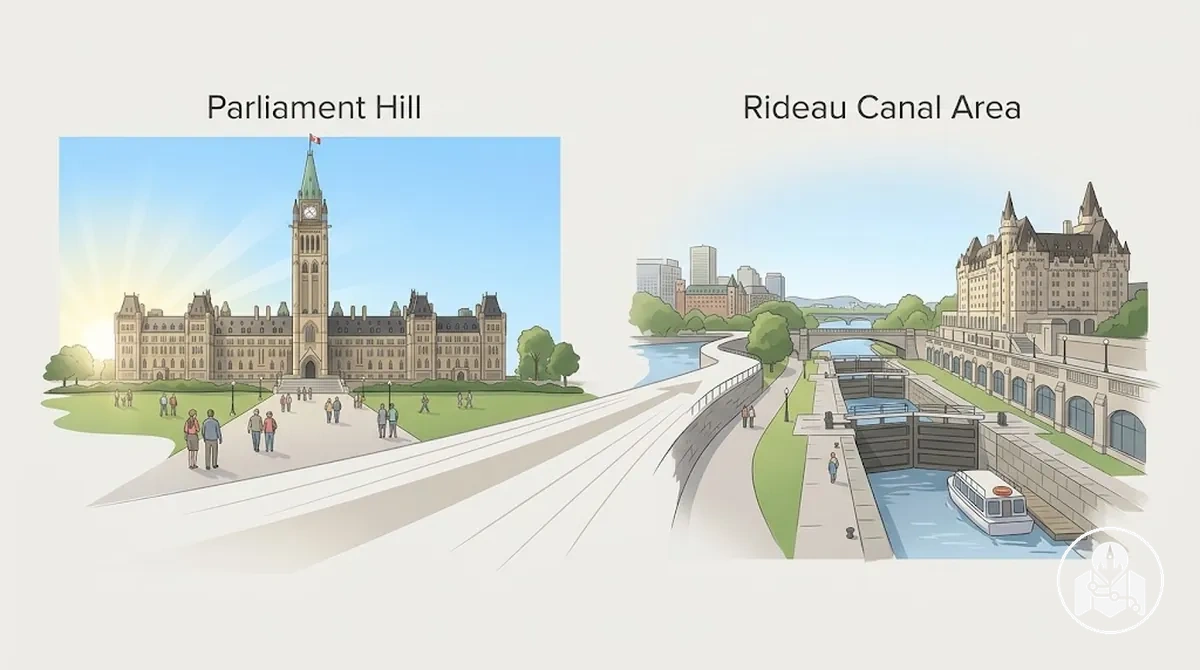
Early placement protects priority stops before later delays reduce the remaining time.
Keep dwell time flexible at each stop: allow more time when access and visitor interest support a longer visit, or shorten the stop when queues, schedule-dependent activities, or access conditions would disrupt the nearby continuation.
- Start at Parliament Hill: Use it as the morning priority stop and allow dwell time that matches the sightseeing available on the day. Shorten the visit if access or queues would consume too much of the morning; extend it when available access and your preferred visit depth justify more time.
- Continue to the Rideau Canal area: Use this nearby central landmark as the next compatible stop rather than crossing the city. Keep the visit shorter when remaining morning time is limited, or extend it when your pace and access conditions leave enough time for a longer look.
Tours, ceremonies, and other scheduled activities should be treated as optional unless their availability is verified for the day.
Keep the morning route focused on nearby central sights so the remaining time can continue smoothly into midday.
Midday: Continue Through Nearby Downtown Stops
At midday, continue through nearby downtown stops so proximity preserves sightseeing time and avoids unnecessary backtracking. Use ByWard Market as the principal midday anchor within the central cluster rather than adding a separate cross-city detour.

ByWard Market fits the midday route because it keeps the itinerary within the downtown cluster and supports an efficient connection to the next destination.
Keep dwell time flexible according to the remaining schedule and your level of interest: a shorter visit preserves more time when the morning has run long, while a longer visit can fit when the earlier stops finish without significant delay.
This keeps route efficiency tied to proximity and available time rather than forcing a fixed midday duration.
Afternoon: Add a Museum or Secondary Landmark
In the afternoon, add one substantial museum or secondary landmark only if the remaining time and route position support it.
Treat the afternoon option as a conditional choice rather than an automatic extra stop, because a longer indoor visit may replace another major stop.
Evaluate the choice through visit duration and location first, then check the opening window and thematic interest.
Time and route fit determine whether an option is practical; thematic interest determines which suitable option deserves the available afternoon.
- Visit duration: Choose an option whose likely dwell time fits the remaining time; a substantial museum visit can replace another major stop rather than supplement it.
- Location: Prefer a museum or secondary landmark that fits the current route position; an option requiring more movement consumes more of the available afternoon.
- Opening window: Include the stop only when its current access window fits the planned arrival and likely visit duration; verify current hours or access conditions before relying on it.
- Thematic interest: Use personal interest to decide which suitable option deserves the available time after its time and route fit are established; greater interest can justify allocating more of the afternoon to one substantial stop.
Examples include the National Gallery of Canada or the Canadian Museum of History, but choose one only when its location, likely visit length, access window and your interest fit the afternoon. A substantial indoor visit may replace another major stop, leaving the evening choice dependent on the remaining time.
Evening: Complete the Final Priority Stop
Use the evening for one final priority stop only if it still adds distinct value and fits the remaining time, remaining daylight or opening time, current location, and energy level.
The endpoint should adapt to the day rather than force another attraction into the schedule.
For example, ByWard Market or a canal-side walk can work as an evening finish if that experience has not already been fully covered and the remaining time, access conditions, distance, and energy level still support it.
Treat the final stop as an adaptable endpoint rather than a fixed evening requirement.
Adjust the One-Day Itinerary When Timing Changes
A timing change should first be interpreted by what changed in the schedule—such as a late start, queue, closure, longer visit, weather disruption or transport delay—before choosing a correction. Protect the highest-priority remaining experience first, then adjust lower-priority stops rather than trying to recover every lost minute.
The troubleshooting goal is to restore a workable route around the remaining time and priority stops.
A useful corrective direction may be to shorten a lower-priority stop, remove a distant or time-intensive option, regroup the remaining route, or change the transfer method when the time saving is meaningful.
The diagnostic table links each timing symptom to a possible cause, a quick check, and the least disruptive corrective direction.
Where transfer choice is part of the problem, choose how to get around Ottawa according to the remaining route rather than changing transport automatically.
| Timing symptom | Possible cause | Quick check | Corrective direction |
|---|---|---|---|
| The day starts later than planned | A late start may reduce the time available for lower-priority stops. | Check the remaining time, current opening windows, and which priority stop still needs protected time. | Keep the highest-priority stop and shorten or remove a lower-priority option. |
| A stop is taking longer than expected | A queue, longer visit, or slower-than-expected pace may be consuming the schedule. | Check whether the current stop is still worth the extra dwell time compared with the next priority stop. | Shorten the current visit when appropriate or remove a later lower-priority stop. |
| A planned attraction is unavailable | A closure, access restriction, or changed opening window may have disrupted the route. | Check whether a nearby alternative still fits the same geographic cluster and remaining time. | Regroup the route around nearby priority stops instead of replacing the closure with a distant attraction. |
| Movement between stops is taking too long | A transport delay, congestion, backtracking, or a poorly positioned next stop may be responsible. | Check the distance to the next priority stop and whether another transfer method would materially reduce travel time. | Change the transfer method when useful, or remove the distant stop and keep the remaining route compact. |
| Weather disrupts an outdoor part of the plan | A weather disruption may make the planned outdoor sequence impractical. | Check which remaining indoor or sheltered option still fits the current location, opening window, and priority order. | Regroup the route around a suitable nearby stop and postpone or remove the affected lower-priority outdoor stop. |
The corrective direction changes with remaining time, attraction importance, and geographic position.
A local queue may require only shortening one lower-priority stop, while a closure or major transport delay can justify removing a distant option and regrouping the rest of the route.
If the same timing problems repeatedly come from overloading the day or poor sequencing, avoid common itinerary planning mistakes rather than treating each problem as an isolated delay.
A successful adjustment preserves the priority experience coherently even when the original schedule cannot be recovered in full.
The aim is not to maximize the raw number of stops, but to keep the remaining itinerary practical, geographically sensible, and focused on the most important experiences.